

My First Reaction and Accepting My Ileostomy
It’s understandable that some patients might experience psychological and body image issues after having an ileostomy. The idea of having a part of your intestine or stoma sticking out of the front of your abdomen discharging smelly faeces would be expected to be offensive to most people. I should at the outset point out that the effluent which exudes from an ileostomy is from the small bowel and not the large bowl. Consequently it is only partially digested, more fluid, less smelly and does not have the odour or the bacteria present from large bowel faeces. Consequently it is far less odorous and offensive than faeces and I therefore prefer to call it effluent.
Looking after your ileostomy
There is also the need to take care of your ileostomy and frequently empty the stoma bag 5 or 6 times a day. Whilst this may be tricky at first is can quickly become an exercise taking less than 5 minutes, and which is clean and tidy. Although initially daunting, if necessary it can easily be undertaken when out and about in public toilets. Changing the bag is essential every 48 hours. From experience I know that slowly the bag contents creep through the seal of the stoma bag to the skin. Delaying changing the bag for more than 48 hours runs the risk of the bag leaking or bursting with effluent running out under your clothes, onto the bed clothes, mattress or the floor. This is best avoided at all costs by carefully and regularly changing the bag. Each time ensuring that the skin is clean and dry before sticking the ileostomy bag’s sticky pad down onto the skin around the stoma. With time this too can be a fairly straight forward task taking 5 – 7 minutes.
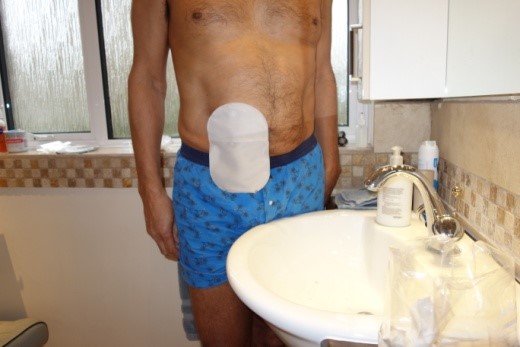
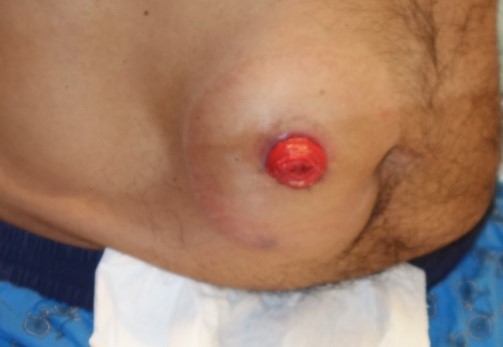
Therefore taking these factors into account for the lay person, the uninitiated or those who have this unexpected outcome from surgery. It is not surprising that many patients at the outset have an problem with the acceptance of their stoma and the need to care for it, a disrupted body image and psychological problems. Education, training and psychological support are the main tasks for the dedicated stoma nurses.
My own experience with my ileostomy
Being medically trained, I felt differently about having an ileostomy. I had already been involved with and trained in managing such surgery. Perhaps this was the reason why I felt that I had no justification in raising any complaint when unfortunately I came to require one. Perhaps more importantly I knew and recognised that I had been seriously ill prior to the surgery and for more than a year had made every effort possible to avoid surgery.
In the end, I had 2 episodes of obstruction and toxic megacolon within a month. This was only controlled by judicious use of antibiotics, particularly strong bowel antibiotics such as Ciprofloxacin. By that time, I had lost approximately 20% of my body weight i.e. almost 20 kg. I recognised that I was at risk of bowel perforation and should probably have been hospitalised. It could be so that the seriousness of the preceding illness and knowing what the surgical options were, has made it easier for me to accept the fact that I now had an ileostomy. Thus, I had no problem whatsoever in dealing with the necessary maintenance that comes with that kind of surgery. It probably also helped that I knew that this should be a temporary problem and that in my case the ileostomy could probably be reversed after three months.
I knew that surgery was now essential
Therefore, I knew that surgery was essential. I was reassured that I had expressed my wishes to both my surgeons that when the diseased segment of large bowel was removed a primary anastomosis (join up) of the bowel was undertaken if posisble. ML told me that he and my other surgeon had jointly decided during surgery that the safe option was to do a temporary ileostomy, allow the primary bowel anastomosis to heal before subsequently, after three months, reversing the ileostomy and restoring the continuity of the intestine. This allowed the primary anastomosis (join up) to be protected for three months with an ileostomy that would divert the contents of the digestive system away from my large bowel and the anastomoses. Also, this would allow enough time for the dilated large bowel to recover.
To put it in a few words – knowing the importance and relevance of this procedure along with my memory of being significantly ill prior to surgery, I fully accepted the ileostomy, my altered body physicality and the need to manually deal with my bowel effluent. I hope that in recounting my experiences might help and guide others through what is a difficult time.
Therefore, I was reassured once again when my consultant visited me the morning after surgery and was happy that I had an appetite and was eating soft, easily digestible foods. I was fairly comfortable sitting up and regularly wiggling my toes, feet and ankles to maintain the circulation. Feeling around my stomach, I noticed that the skin on the right side of my abdomen was less sensitive. I reminded myself that Dr Dodds (my anaesthetist) had told me that he would use local anaesthetic and undertake nerve blocks that would render my abdominal wall numb or less painful in the post-operative period.
Disclaimer: This information is only provided for general and background reading. The information should not be relied upon for treatment. The views provided are not necessarily those of the author or of the website. You should always take advice from your own general practitioner or treating specialist before a treatment is commenced or altered. In individual circumstances liability is not accepted for any reason by my-ileostomy.co.uk